Making a Portfolio!

Making a portfolio is really important especially if your a makeup artist as it is a professional way to showcase your work and demonstrate you skills. It is also a really good way to promote your business and show potential employers your work. It is also a nice way to show your progress from when you started especially if you keep dates on your pictures!

In your portfolio you want to have good quality pictures with clean backgrounds as these look the most professional. You also want a variety of images to show that your are a versatile artist and are capable of creating a number of different looks! For example clean makeup, editorial makeup and creative makeup.

Final Exam Body Art Evaluation

Firstly, I hung up sheets to create curtains for my model to stand behind to make him feel more comfortable. I then set out my equipment to ensure I had everything I needed and that I wouldn’t run out of anything. I then hung up my background and marked exactly where my model was stood so I knew exactly where to position him whenever he moved, I also marked where I would be standing so I knew where to stand when looking back and checking. Once I was set up and my model had everything he needed I was happy to begin the application.

For the application I first gelled my model’s hair slick back as he has very curly hair and I needed to get it as flat as possible for when I applied my bald cap. Once the hair was gelled I applied the bald cap step by step using a prosthetic adhesive and made sure the edges were as smooth as possible. Overall, I was happy with the bald cap application however the edges could have been slightly neater towards the back.

Once the adhesive was dry I began to sketch the outlines of the shapes around the perimeter of my model to match up with the background. I kept looking back to ensure each line matched up perfectly. I found this very challenging to get the hang of as it was difficult to get the lines so precise. Once all the lines were evenly matched I began to fill them in by stippling the face paints on using a dense brush as this would give the most coverage. This was my first body art technique as in the brief it states that we must include a minimum of 3 techniques. Next, I used a splattering technique using a fluffier brush and flicking the paint on. I found this method really easy.

My final body art technique was outlining. I used this around each paint splodge to get an even outline before painting the black background.

When all the edges were outlined, I used the back bubbling technique to mix a blue and red airbrush paint together to create a purple. This was an effective way to mix paints however it did get a little messy. I then went onto the middle section of the body and this is where I used a stencilling technique. I also used the airbrush while doing this to get a precise application. I found this technique easy as my model helped hold the stencil still whilst I painted over it and it came out just as I expected it to.

My model preparation really came in handy during the application as I previously asked my model to shave his legs, chest and face to remove any hair, so I had a clean canvas to work on and the paint would go onto the skin much smoother. I also asked my model to wear black boxers as the main colour of my background is black, so it would blend in nicely.

Overall, I was highly satisfied with my work as I camouflaged my model into my chosen background, met the brief and followed all health and safety precautions whilst looking after my model.

Final Exam: Avant Garde Interpretation Evaluation!

Firstly, I set out all my equipment neatly to make sure I had everything that I needed and to be time efficient. I had previously washed all my brushes using a specific brush cleanser to kill off any bacteria and to meet the hygiene standards. Then to follow health and safety precautions I tied my hair back, washed my hands, and removed all my bags and cases from the floor to prevent any accidents. I then asked my model to put on a green velvet dress which was part of the costume so that it wouldn’t ruin the hair if I did it afterwards. I then equipped my model with PPE such as a gown to cover her clothes to prevent any makeup getting onto them. I personally believe I successfully succeeded in the preparation stage.

To begin the application, I started by lightly spraying my model’s hair with heat protectant to reduce any damage caused from heat. I then crimped her hair to create as much texture and volume as possible and brushed it through. Once it was all crimped I began to section the hair in horizonal sections starting right from the front of her head and securing each section with a clear elastic band. When doing this I made sure the sections were straight and that there were no fly away hairs and I used hair gel to keep it sleek. Towards the bottom sections I began to add clip in hair extensions to add length to my model’s hair and I crimped these as well to disguise them. I also made sure the clips were fully covered to avoid losing any marks. Next, I joined each section to the one below it and pulled it out slightly to make them as big as possible. This was to create the effect of dinosaur spikes as this was my inspiration. I was very happy with how the hairstyle turned out. The next step was to colour my model’s hair using a green hairspray. Not only did this colour her hair but it also helped the sections to hold their shape. I used a fan whilst doing this to help with ventilation and rubber gloves to stop any of the hairspray getting onto my hands. Overall, I was super happy with how my avant garde hairstyle looked so far, however I decided to add in ornamentations as a finishing touch.

To begin my avant garde makeup I applied prosthetic horns which I had previously made. I applied these using a prosthetic adhesive and held then in place until there were dry to stop them from lifting. Once these were secure I went around the edges with latex to help them blend into my models’ skin and to make them look realistic. Whilst the latex was drying I drew on my models’ eyebrows using a green face paint then carved them out using concealer to make sure they were precise.

For the eye makeup I primed the eyelids to create a clean canvas to work on and to block out any veins or pigmentation that my model had. I then started to blend a variety of green eyeshadows into the crease and winged them out slightly. I added depth into the outer corners using a black shadow. Next, I cut the crease with concealer and packed on a pink shadow to add vibrance into my look. In my look book I had planned on using a shimmery green pigment on the lids however when I was creating my look I realised I wanted the eyes to look brighter and more vibrant. I chose pink as this tied in with the hair as I knew I was adding in some pink flowers. I then used a gold glitter liner where I had cut the crease to add a little bit of shimmer as well as highlighting the inner corners. To complete the eye makeup I added mascara and a pair of big fluffy lashes. I decided I didn’t want to add any shadow onto the lower lash line, instead I wanted it to be crisp and clean.  Overall, I was happy with how the eye makeup turned out however next time I would add some bottom lash mascara because now looking back on the pictures I had taken I do think it lacks that slightly.

When the eyes were complete I went back onto the base and applied a full coverage foundation to help hide my model’s redness and blemishes then lightly set it all in place with loose translucent powder to ensure it lasted and to reduce any shine caused from the prosthetic adhesive and the liquid latex as this would pick up on the camera and loose me marks. After that I applied a green eyeshadow to the contours of my model’s face and around the horns to help hide the edges of the prosthetics even further. To top the contour off I stenciled on some black eyeshadow and used a fly swatter to do this as it had the perfect sized holes to recreate the effect of a reptile’s skin. Again, I was happy with how this turned out as I made sure the stencil didn’t move when applying the shadow to prevent it from smudging. To add texture to the prosthetic horns I painted them white and used a brown face paint and added dry brush strokes to the very tips and base of the horns to help them look more realistic. I also added coffee granules around the base of the horns to give the effect of dirt. To complete the avant garde makeup look I outlined the lips using a black pencil eyeliner, filled them in with a black liquid lipstick then topped it off with a clear gloss. However, I wasn’t happy with the lip line after looking back at the pictures as it could have been neater and more precise therefore this would be something I would improve on if I was to do it again.

Overall, I am satisfied with how the makeup look turned out and would only change certain things such as the lip application, the edges of my prosthetic pieces as they were slightly thicker than what I wanted and adding bottom lash mascara.

Going back to my models avant garde hair I used the fly swatter and a black hairspray to add in the reptile stencil detailing onto the sides of the head to help blend the hair into the makeup. This went very well apart from a small patch where the black hairspray bled slightly and therefore once I had added in ornamentations such as fake leaves, ferns, pink flowers and green pipe cleaners I was careful with my placement of them and managed to cover that mistake up with a flower. I chose to add in leaves, flowers and ferns to incorporate the jungle scenery as Jurassic park is set in the middle of the jungle. Overall, I was pleased with how my avant garde hair went and I wouldn’t change anything if I was to do it again.

For my costume I decided to leave the velvet green dress plain instead of adding fake leaves onto it like I mentioned in my look book as I didn’t want to go overboard. Instead I painted my models’ feet green and added dry brush strokes going up her legs to create the illusion of grass and applied the leaves on top. I then attached my dinosaurs frilled neck which I had previously made using garden wire, cardboard, tape, cellophane and tissue paper to complete my outfit and I was super happy with it.

Overall, I am more than happy with how my avant garde interpretation turned out as it looked exactly how I imagined. I met the brief, exceeded all health and safety precautions and managed to keep my work area clean and tidy.

Final Exam: Character Recreation Evaluation!

In preparation for my exam I set out all my equipment neatly to make sure I had everything that I needed, and it was all clean and sanitized. I had previously washed all my brushes using a specific brush cleanser to kill off any bacteria and to meet the hygiene standards. Then to follow health and safety precautions I tied my hair back, washed my hands, and removed all my bags and cases from the floor to prevent myself or my model tripping over them. Next, I equipped my model with PPE including a gown covering her clothes to prevent any makeup or other products from getting onto them and a towel behind her head to rest on. I also made sure my model was comfortable in her seat and checked she had everything she needed. In my opinion I feel that I successfully accomplished the preparation stage, met all the health and safety precautions and was then happy to start with the application.

Firstly, I sprayed my model’s hair with a light dusting of heat protectant to prevent it getting damaged by heat. I then sectioned my model’s hair, starting from the bottom, and began to curl it using a small barrelled curling wand to create small tight ringlet curls. Once I had curled the bottom sections of hair I sprayed those curls black using a black hairspray because my model’s natural hair is blonde which didn’t fit my brief as Hook’s hair is black. Before spraying the hair I equipped myself with PPE such as gloves and an apron.  I backcombed near the roots to create volume and lift and clipped in long black hair extensions to add length and thickness because my model has short fine hair which again didn’t fit the brief. I continued to curl my model’s hair and the extension’s and sprayed the remaining blonde hair black and made sure it was all completely covered. I chose to do this in sections because with the colour being a black hairspray it can make the hair crispy and this would be quite hard to curl and be more likely to damage my model’s natural hair. Overall, I am slightly disappointed in the way the extensions curled due to them being synthetic. Next time I would pin each curl while they cooled to help hold their shape.

To begin the makeup application, I applied a prosthetic nose using an adhesive and blended the edges away using acetone. However, I found it quite difficult to get a seamless blend and it wasn’t as smooth as I hoped for. To try and rectify this in the future I would ensure the edges of the prosthetic piece are much thinner.  This was my first special effect. For my second special effect I blocked out my model’s eyebrows using glue and translucent powder in preparation for applying my postiche eyebrows. Next, I used wrinkle stipple to age my model’s skin however I did choose a model with more mature skin, so this step was much easier than if my model had younger skin. I also used collodion to recreate Hook’s facial scars. These techniques are also classed as special effects.

Once I was happy with the special effects I applied a thin layer of foundation to make everything the same shade. I then set it in place with powder to help hide the edges of the prosthetic nose and to get rid of any shine from the latex or the prosthetic adhesive, as when pictures are taken it would pick up on the camera and could lose marks. I contoured my models face with a cool toned contour powder to give the illusion of prominent cheekbones and applied a black kohl liner in my model’s waterline and tight line.

For my fourth special effect I had planned on using a set of false teeth which I had previously made using platsil gel however these didn’t work as the platsil gel was too flimsy and wasn’t strong enough to hold the teeth in place. Therefore, I decided against using these and instead coloured my models own teeth using alcohol paints. This was quite disappointing so next time I would use polymorph which is much stronger then platsil gel.

To complete the makeup look I applied postiche eyebrows and moustache which I had previously made. To do this I used a prosthetic adhesive and held them in place until they set.

Overall, I am happy with how my makeup application went apart from the edges of the prosthetic nose and the false teeth.

For the costume I dressed my model in a frilly white shirt with a black waist coat and a big old buckle belt around her waist. I also asked her to put on some faded black jeans and some bulky knee-high boots as this is what Hook wears throughout the film. For my models props I used a black triangular pirate’s hat with white feathers around the rim, a black leather glove, a hook in place of a hand, a small shot gun, a sword and a blow up stopwatch as he is seen carrying this around.


Becky x

Hair and Makeup trends for each era! (Egyptians – Current)

Egyptians:

Makeup- Ancient Egyptians wore extremely elaborate eye makeup and created an almond shaped eye. Both men and woman wore makeup, however woman wore much more colour, had longer lashes and added markings underneath their eyes using kohl. They used perfumed oils to soften their skin and prevent sun burn or damage from the sandy winds. Egyptians had to make their own ‘makeup’ using lavender, malachite, red ochre, kohl and different types of oils.

Hair- Many Egyptians gelled their hair and braided it (cornrow braids) to keep it away from their face and to make it more manageable. Some wore wigs or hair pieces as some choose to shave their heads as part of their culture.

1910’s:

Makeup- Women loved a pale complexion because having a tan suggested you were from the lower class therefore, women of the higher class remained inside or out of the sun. They cleansed their skin regularly with lemon juice to give the appearance of a feminine complexion. They wore minimal makeup only consisting of foundation, powder, blush which was only applied to the apples of their cheeks, cool toned eyeshadows and just a lip stain to add shine.

Hair- Their hair was usually full of volume and free flowing. They wore hairstyles which were known as the ‘undone’ style which were wavy loose pin ups. Hair accessories were often used to add to the look such as metallic headpieces or flowers.

1920’s:

Makeup- The twenties era was know as ‘The Flapper’. This involved women expressing themselves to help recover from the horrors of the war. Women loved a pale complexion which they heavily set with powder to ensure it lasted all day long. They had strong brows to match with their dark, tool toned eyeshadow. They either paired this with a pale nude lip or a bright red and always emphasised their Cupid’s bow.

Hair- In the twenties women said goodbye to long Victorian locks and welcomed much shorter styles. Finger waves were huge during this time and the top section of their hair was always flat to their head and this style was usually paired with a headband, fascinator or a feather.

1930’s:

Makeup- The biggest trend in the thirties would have to be the pencil thin eyebrows. Woman heavily plucked them and didn’t give them much shape. On their eyes were usually pale pinks or greens and minimal mascara, nothing too dramatic. Women over lined their lips and their cupid’s bow to give the appearance of larger and fuller lips.

Hair- Waves and curls were popular in the 1930’s to create amazing volume. Also small detachable braids were used to dress up the look.

1940’s:

Makeup- Despite rationing, women around the developing world began applying makeup from their teenage years. They always had well manicured brows which they lightly filled in with a pencil and added eyeshadows to match the colour of their eyes. They only wore mascara on their top lashes and it was usually brown. Lastly they filled in their lips using a matte red lipstick.

Hair- Women in the forties cut their hair pretty short with a rounded U-shape at the back, curving it up towards the ears. It was also popular to have a side parting and pin curls.

1950’s:

Makeup- Pastel colours rules the 50’s! Pale pinks, greens, blues and yellows. These were worn as clothing or eyeshadow and always paired with a black winged liner. While Russian red was the favourite colour lip gloss. Delicacy was the goal for foundation therefore creams were the way to go.

Hair- The most popular hairstyles in the fifties has to be a bouffant or a victory roll. These were inspired by Marilyn Monroe and are an iconic look.

1960’s:

Makeup- Women in the sixties wore a high coverage foundation to hide any imperfections and freckles. Like in the 20’s they heavily set their base with a loose powder to ensure it lasted. Their main focus was their eyes and therefore wore blue shadow, black floating liner and a pair of big false lashes. They also drew on small lashes underneath their lower lash line. To complete their look they used a very pale nude lipstick to ensure no attention was taken away from their eyes.

Hair- The most iconic hairstyle in the 1960’s is of course the ‘beehive’. This is a conical shape on top of the head and consists of lots of back combing to create immense volume.

1970’s:

Makeup- In the 70’s they were two completely different styles of makeup one consisted of a light coverage base, shimmer eyeshadows, blush and shiny lipgloss. Whereas the other consisted of dramatic dark smokey eyes, contour, dark brows and a berry toned lip. This one was classed as an evening look.

Hair- Curly perms were the in thing during the seventies and everyone wanted one.

1980’s:

Makeup- Women in the eighties ‘painted’ their faces. They wore the brightest eyeshadow they could fine, coated their lashes in electric blue mascara and heavily contoured their faces. They also wore a bright lip to match their bright eye makeup.

Hair- In the 80’s the majority of woman had blonde hair, this was the ‘fashionable hair colour’ and everyone wanted blonde hair. Layers were super popular and usually curled outwards away from their face so they flicked out. A popular men’s hairstyle in the 80’s was a mullet!

1990’s:

Makeup- Foundation had come a really long way since the earlier decades and therefore it became much harder to find the correct shade. It was usually matte and didn’t require a setting powder. Blush was applied to the apples of their cheeks and they had very natural looking brows and they only wore a clear lip gloss.

Hair- The ‘Rachel’ hairstyle was the most popular in the 90’s and this was named after Jennifer Anderson’s hairstyle in the ‘FRIENDS’ TV series. Hair accessories such as butterfly clips and scrunches were also popular!

2000’s:

Makeup- Fake tan was introduced in the early 2000’s and women went over the top. This made it super difficult to match their foundation and this is where the ‘slag line’ was introduced. Pencil thin brows made a reappearance in the 2000’s as well as clumpy eyelashes. To complete their look they heavily contoured their faces and applied a very pale nude lip. This was known as ‘concealer lips’.

Hair- Pigtails we’re popular in the 2000’s era along with side ponytails. Adding coloured streaks into your hair was classed as fashionable however looking back this was a huge mistake.

Current Trends:

Makeup- Makeup now is much more advanced and precise for example eye makeup has become much more complex and involves cut creases and spotlight eyes. Contouring has become a staple to enhance cheekbones and to ‘snatch’ the nose making it appear thinner. Over lining lips is also important to make them look bigger and fuller.

Hair- Braids have become popular again as well as super bouncy curls. These are sometimes combined to create a pinup usually worn to a wedding or a prom!

Becky x
Making a bald cap!

To make your own bald cap is pretty simple and only requires 4 things; liquid latex, a plastic head, a sponge and loose powder (talcum powder works just as good).

To begin with you must apply a thin later of liquid latex onto your plastic head using your sponge. It is easier to apply thin layers because it will reduce any lumps and bumps. You want the latex to be as smooth as possible. Next, you have to add another layer over the top but you must make sure each layer is dry before adding another because if not the latex will lift and this isn’t what you want. Keep adding layers until your happy with the thickness of your bald cap but don’t carry all the layers right to the edges as you want the edges of your bald cap to be thin so it will blend into the skin easier once it’s applied and it will look much more realistic.

Once your happy with the layering of your bald cap and it has completely dried you can powder over the top to set the latex. Then carefully peel up the edges and heavily powder underneath to prevent the latex from sticking. Once it has all been removed your bald cap is ready to apply!

Becky x

Camouflage into a background!

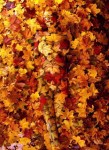
Camouflaging a person into a background is much easier said than done. One thing you have to consider is your positioning and where you will be taking the photo from to ensure your lines match up perfectly all the time. This is harder than you think because you have to keep stepping back to check your positioning and it’s very easy to draw a line in the wrong place or at a wrong angle.

The easiest way I found was to draw small dots using a white face paint to mark where the lines needed to go and then to fill in using colour. Using a white face paint to map things out is much easier to remove than a deeper colour if anything went wrong.

Another aspect you need to consider wouldn’t be your models position as they would need to stay in the exact same place the entire time to ensure the lines painted matched up to the background. You need to check your model is comfortable and is alright throughout the process. If your model did happen to move it would be quite difficult to match them up again but your model always comes first.

I found this camouflaging into a background very difficult but the busier the background is the easier it is to disguise any mistakes.

Here a few examples I have found in the internet:

Becky x

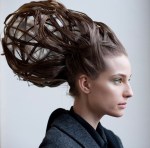
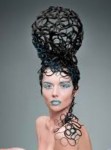
Avant Garde Hairstyling – Caging

To create this Avant Garde hairstyle you have to start by blowing up a balloon and pinning it to the centre of your models head. (The bigger the balloon the longer the hair has to be as there’s more to cover.)

Once you have pinned your balloon down you can then start to take tiny sections of hair and completely coat them in hair gel then place them onto the balloon. When doing this you want to make sure you comb each section to ensure that there aren’t any knots and the hair is smooth as this will help it to stick. You must continue doing this with each section of hair until the entire head is complete. You can either lay the hair in straight lines or you can curl the hair around the balloon to create patterns.

Once it’s covered and your happy with it you can spray the hair with hairspray and then you must leave it to completely dry and wait for it to go crispy before you pop the balloon because if not the hair won’t hold its shape and it will just collapse.

Becky x

Airbrushing!

First of all we started by setting up our work area and ensuing our surface area was covered to prevent paint from getting onto our clothes and on the furniture. We then learnt how to construct and deconstruct the gun which I found pretty simple and easy to follow.

To construct an airbrushing gun you must start by carefully placing the needle into the end of the gun by threading it through the designated hole. You must be very careful when doing this as it is very easy to bend the tip of the needle and this then won’t be easy to use, as the needle is used for the direction of the paint flow. Once your needle is in you can secure it with a needle cap and then place and attach the handle over the top. Once this is set up you can attach it to the compressor.

Once our guns were all set up we used water based paints (as these are really thin in consistency and won’t clog up the needle) and had a play around using the gun and getting used to how to work it.

To use an airbrushing gun you start by plugging it into the compressor which compresses the air. You then have to carefully pour some paint into the colour cup and press down and pull back the trigger to produce the paint and the air. (Pressing down the trigger produces the air and pulling back the trigger produces the paint so you have to do both at the same time.) The more you pull back the trigger the more paint it will produce. To get more coverage you have to go closer to the skin and to sheer it out you go further away. This is a really good way to get a smooth gradient.

To mix colours in the colour cup we used a technique called back bubbling and this is where we had two different colours in the cup and you cover the end of the gun (where the air and paint comes out from) with your finger, and this causes the paint to bubble and therefore mixes the paints together.

When washing your airbrushing gun you must use hot water as this will break down the paint. Start by running it under the tap and letting the water run through the colour cup and down inside the needle as this is where the paint is most likely to build up. Then press and pull down on the trigger multiple times to ensure the hot water gets throughly inside the gun. Once the gun looks clean and the water starts to appear relatively clear you must deconstruct your gun and throughly wash all the parts. Then dry everything with a towel and reconstruct ready to use again.

Becky x

Mock 2: Look 3 – Pablo Picasso Inspired Body Art!

Firstly, I hung up sheets to create curtains for my model to stand behind in order for him to feel more comfortable. I then set out my equipment to ensure I had everything I needed and that I wouldn’t run out of anything and placed a plastic sheet on the floor to prevent any paint from going on the floor. I then turned on the lights around my station to ensure that I had good lighting and therefore I could check my application of the face paint wasn’t streaky. When I was set up and my model had everything he needed I was happy to start.

I began by painting lots of different random shapes (squares, triangles, circles etc) on my models’ chest, stomach and arms using a variety of different brightly coloured face paints. I then connected each shape up to make sure no skin was showing and to the ensure all the skin was completely covered with paint. This part was very simple, and I made sure that all the shapes were as neat and precise as I could get them. I used small dense brushes to do this as this would give me the highest coverage and I made sure the paint was a thick consistency to prevent streakiness. I also kept referring to my body chart which I had previously drawn. I then moved onto my model’s legs whilst his upper body was drying. I started by painting random objects such as a pineapple, guitar, pencil and an umbrella, as Picasso often incorporated random objects into his paintings. I then filled in the rest of the legs with shapes just like I had done on his upper body, so no skin was showing as in the brief it states that only 25% of the body can be covered with clothing and this was my model’s boxers. I also found this step simple, but my model did have hairy legs, so it wasn’t as easy to paint over the hairs. Therefore, next time I would ask him to shave his legs, so the paint will go on much smoother. My model was wearing black boxers, so it was impossible to paint over so this would also be something I would change next time.

While his whole body was drying I began to apply a bald cap which I had previously made. To do this I started by gelling my model’s hair slick back. Then I carefully placed the bald cap on my model’s head and applied a prosthetic adhesive around his forehead and step by step secured it down. I worked my way from the front of his head towards the back as it was only a frontal piece we had to create so I wanted it to be very neat around the front. I found this much easier than last time as my bald cap was much stronger and the edges were very thin, so it looked less obvious. Once the prosthetic adhesive was completely dry and the bald cap was secure I started to paint my models face. I chose to do his face last as he doesn’t enjoy having his face touched and he is also insecure about his skin, so I didn’t want the paint to be on as long and to perhaps irritate him. I was careful with the placement of the paint on the seam of the bald cap and tried my best to hide it by using darker colours such as black and dark blue. On my models face I chose to incorporate disorientated faces as this is a huge aspect in many of Picassos paintings as well as his unique style of art ‘Cubism’ which is why I chose shapes on the rest of my model’s body. Once I had pained the disorientated faces on his face and neck I went around every single shape, feature and object with a black face paint to make them stand out and this is also something Picasso does in his paintings. I tried to be as neat as possible when outlining the shapes but again the hairs were quite difficult to paint over.

Overall, I was happy with the look I had created as you could tell it was a Picasso inspired, I had met the brief and followed all health and safety precautions. However next time I would change certain steps such as the colour of my model’s boxers, and to shave him so there would be no hairs.

Becky x